How AI Chatbots Are Replacing Contact Forms — And Generating More Leads
The Problem With Contact Forms in 2026
Contact forms were built for a different era of the internet — one where waiting 24 to 48 hours for a reply was acceptable, and where visitors were patient enough to fill out fields and trust that someone would follow up.
Today's website visitors are not that patient. Research consistently shows that the probability of qualifying a lead drops dramatically if the response takes longer than five minutes. A contact form that sits in an inbox overnight is not just slow — it is losing you business.
The deeper problem is structural. A contact form is passive. It sits on a page and waits. It does not engage the visitor, does not answer their questions, does not address objections, and does not adapt to what the visitor actually needs. It is the digital equivalent of handing someone a clipboard and asking them to come back later.
What an AI Chatbot Does That a Contact Form Cannot
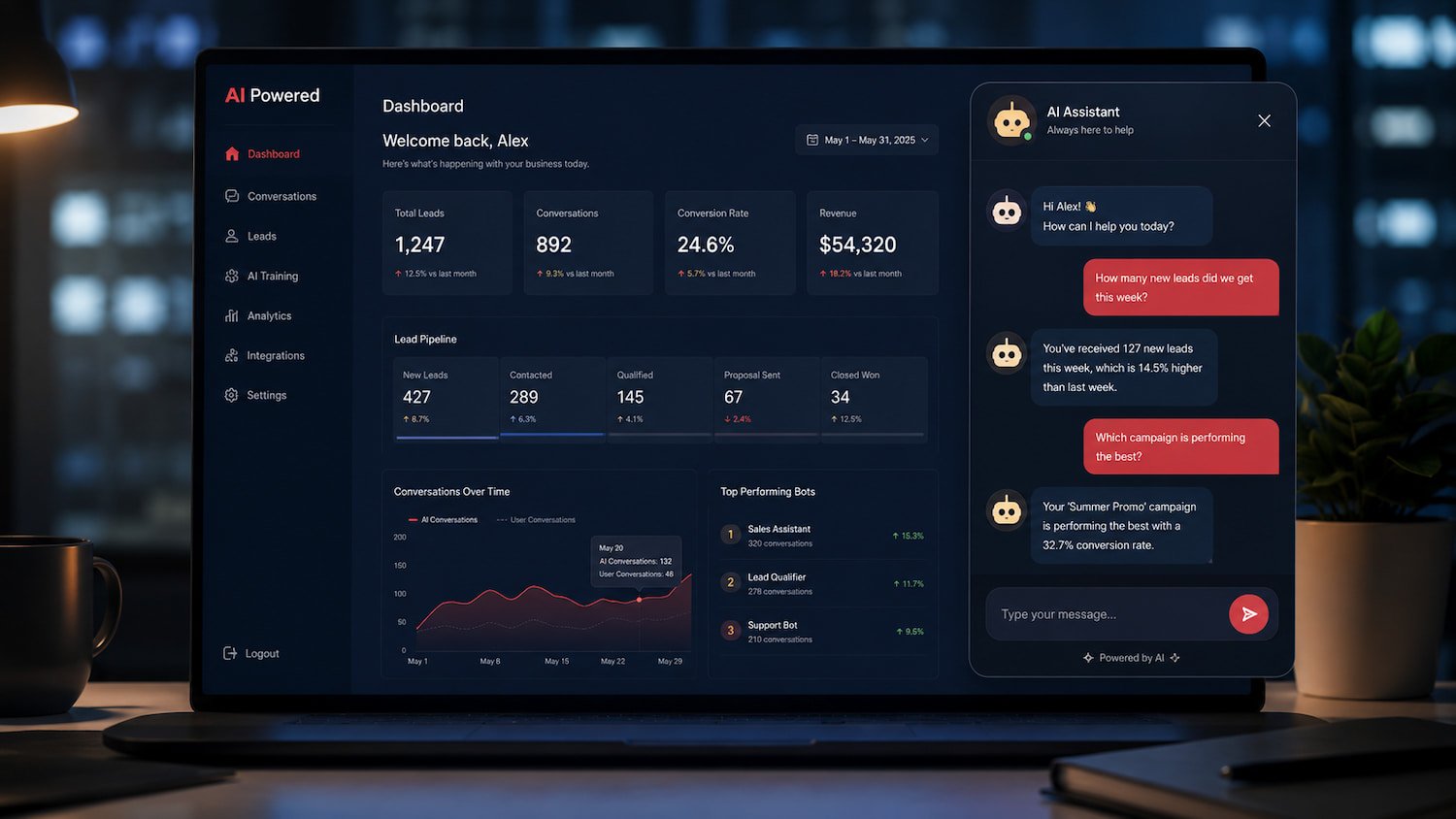
An AI chatbot is not just a faster contact form. It is a fundamentally different kind of conversion tool. Here is what sets it apart:
It Engages the Visitor Proactively
A well-configured chatbot does not wait to be clicked. It can initiate a conversation after a visitor has been on a page for a set time, or when they show exit intent. This proactive engagement alone can recover a significant percentage of visitors who would otherwise leave without making contact.
It Answers Questions Instantly
One of the main reasons visitors do not fill out contact forms is that they still have unanswered questions. An AI chatbot — trained on your services, pricing FAQs, and business details — can answer these in real time, removing the friction that stops people from converting. This is especially powerful for businesses like lead generation and e-commerce, where product or pricing questions are common barriers.
It Qualifies Leads Before They Reach You
Instead of receiving a vague form submission that says "I'm interested in your services," a chatbot can ask targeted qualifying questions — budget, timeline, company size, specific requirements — and route the lead appropriately. By the time the conversation reaches your sales team, the prospect is already pre-qualified. This is the kind of intelligent filtering that effective lead generation is built on.
It Works Around the Clock
If your business serves clients in the US, UK, or other international markets from a base in India, the time zone gap is a real challenge. A contact form submitted at 9pm EST sits unanswered until the next morning IST. An AI chatbot handles that enquiry immediately — capturing the lead, providing initial information, and booking a follow-up call at a convenient time. Our chatbot development service is specifically built to solve this cross-timezone challenge.
It Personalises the Experience
A contact form is the same for every visitor. An AI chatbot can adapt its tone, questions, and recommendations based on which page the visitor is on, how they arrived, and what they have already interacted with. A visitor on your pricing page gets a different conversation than one reading a blog post — and both experiences are more relevant than a generic form.
Contact Form vs. AI Chatbot: A Direct Comparison
| Feature | Contact Form | AI Chatbot |
|---|---|---|
| Response time | ✗ Hours to days | ✓ Instant, 24/7 |
| Lead qualification | ✗ None — manual review required | ✓ Automated qualifying questions |
| Visitor engagement | ✗ Passive — waits to be found | ✓ Proactive — initiates conversation |
| FAQ handling | ✗ None | ✓ Trained on your business data |
| Appointment booking | ✗ Not possible | ✓ Integrated calendar booking |
| Personalisation | ✗ Same for every visitor | ✓ Adapts by page, source, and behaviour |
| CRM integration | Basic (email notification) | ✓ Full CRM and pipeline integration |
| Multi-language support | ✗ Not native | ✓ Supports multiple languages |
| Abandonment rate | High — visitors leave without submitting | Low — conversation format reduces drop-off |
Spree Marketing builds custom AI chatbots trained on your business — from basic lead capture to full conversational sales assistants. Explore our Chatbot Development service →
Which Industries Benefit Most From Website Chatbots?
AI chatbots deliver results across almost every industry — but some see particularly strong gains. Here are the verticals where the impact is most significant:
E-Commerce & Retail
Product recommendations, order tracking, cart abandonment recovery, and instant answers to shipping or returns queries. A chatbot can drive purchases directly within the conversation.
Healthcare & Clinics
Appointment booking, symptom triage, insurance queries, and patient intake — all handled before a staff member is ever involved.
Travel & Hospitality
Destination queries, booking assistance, itinerary FAQs, and upsell opportunities (room upgrades, excursions) delivered conversationally.
Financial Services
Product eligibility checks, loan or insurance queries, and lead qualification — with routing to a human adviser for regulated conversations.
Software & SaaS
Demo booking, pricing plan guidance, technical FAQs, and onboarding support — reducing churn and increasing trial-to-paid conversion.
Real Estate
Property enquiries, viewing bookings, location filtering, and buyer or tenant qualification — all without manual agent involvement.
Spree Marketing serves clients across several of these industries — including travel & hospitality, healthcare, retail & e-commerce, and banking & financial services. Each chatbot we build is configured specifically for the industry it serves.
How to Replace Your Contact Form With a Chatbot: 5 Steps
- Audit your current contact form performance Before switching, establish your baseline. How many visitors see your contact form? What percentage submit it? How long does it take your team to respond? These numbers will help you measure the improvement a chatbot delivers.
- Define the chatbot's goals and conversation flows Decide what you want the chatbot to do — capture leads, book calls, answer FAQs, qualify prospects, or all of the above. Map out the key conversation paths based on the most common questions your sales team handles. A good lead generation strategy starts with understanding what your prospects actually need to know before they convert.
- Train the chatbot on your business Feed the bot your service descriptions, pricing FAQs, case studies, and objection-handling scripts. The more context it has, the more accurately it represents your brand and the more useful it is to visitors.
- Integrate with your CRM and calendar Connect the chatbot to your existing tools — whether that is a CRM, Google Calendar, WhatsApp, or an email marketing platform. Every lead captured should flow automatically into your pipeline without manual data entry. For businesses also running PPC campaigns or social media advertising, having chatbot leads feed directly into your CRM is essential for attribution.
- Test, monitor, and optimise Launch with a core set of flows and monitor conversation drop-off points, unanswered questions, and conversion rates. Refine the conversation paths monthly — a chatbot that is actively maintained consistently outperforms one set up and forgotten.
Should You Remove Your Contact Form Entirely?
Not necessarily — and this is an important nuance. For some visitors, especially those making formal enquiries or submitting detailed briefs, a contact form still serves a purpose. The smarter approach is to use both: a chatbot as the primary, proactive engagement layer, with a contact form available as a fallback for those who prefer it.
Think of the chatbot as the front-of-house conversation and the contact form as the formal option for visitors who need it. In this setup, the chatbot handles the majority of enquiries and the contact form handles the rest — giving you the best of both without alienating any segment of your audience.
The key is ensuring your website design and user experience presents the chatbot as the default path, with the contact form clearly available but not competing for attention.
Ready to move beyond the contact form? Spree Marketing designs and deploys AI chatbots for businesses across India, the US, and the UK. Talk to our team about your chatbot project →
Frequently Asked Questions
Are AI chatbots better than contact forms for lead generation?
Yes. AI chatbots engage visitors in real time, qualify leads through conversation, and respond instantly — whereas contact forms are passive, create delays, and see high abandonment rates. Chatbots can increase lead capture rates significantly compared to standard contact forms.
How does a chatbot qualify leads automatically?
A chatbot qualifies leads by asking targeted questions during the conversation — such as budget, timeline, location, or service requirements — and scoring or routing the response before a human is involved. Your sales team only speaks to prospects who are already a good fit.
Can a chatbot work outside business hours?
Yes. One of the biggest advantages of an AI chatbot is 24/7 availability. It captures leads, answers FAQs, and books appointments even at midnight, on weekends, and during public holidays — without any human intervention required.
What types of businesses benefit most from AI chatbots?
Any business that generates enquiries through its website can benefit — including e-commerce, healthcare, travel, financial services, real estate, and software companies. Chatbots are especially valuable for businesses with high enquiry volumes or international audiences across different time zones.
How long does it take to set up an AI chatbot?
A basic lead-capture chatbot can be set up in a few days. A fully custom AI chatbot — trained on your products, services, and FAQs, with CRM integration and multi-language support — typically takes two to four weeks depending on complexity.
The Contact Form Had a Good Run — But Its Replacement Is Here
AI chatbots are not a gimmick or a future trend. They are a proven, deployable conversion tool that outperforms contact forms on almost every metric that matters — response time, lead quality, conversion rate, and availability. For businesses serious about growing their pipeline, the question is no longer whether to add a chatbot. It is when.
At Spree Marketing, we build AI-powered chatbots tailored to your business — integrated with your CRM, trained on your services, and designed to convert. Whether you need a simple lead-capture bot or a fully conversational sales assistant, our team handles the entire build from strategy to deployment. Learn more about our Chatbot Development service or get in touch with our team today.