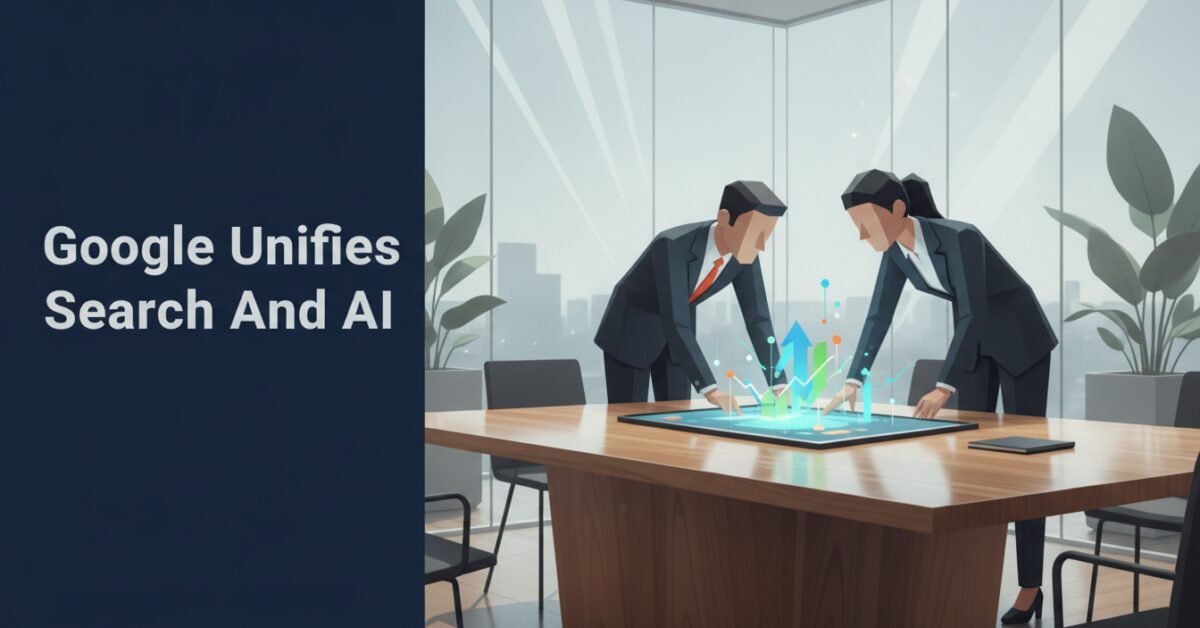
Corporate earnings calls often focus primarily on top-line revenue, operating margins, and macroeconomic tailwinds. Yet Google’s recent corporate commentary revealed a much deeper structural transformation: traditional web search and generative artificial intelligence are no longer developing along separate product roadmaps. Google is consolidating these initiatives into a single ecosystem. Search is no longer functioning merely as an information index; it is actively transitioning into an agent manager built to coordinate complex, multi-step tasks across the open web.
The Shift from Indexing to Agent Management
For more than two decades, web search operated under a clear contract: a user typed a query, an algorithm scanned indexed documents, and the engine served a list of hyperlinked references ranked by relevance and authority. Generative previews and chat interfaces initially arrived as experimental add-ons flanking this core system. That architectural separation is now disappearing entirely.
As unified AI search becomes the standard operating model, Google is rewiring its infrastructure to act as an autonomous coordinator. In this paradigm, an agent manager does not simply deliver candidates for a user to read; it interprets broader commercial and informational intent, coordinates subsidiary AI models to resolve individual components of that intent, and interacts directly with web infrastructure on the user’s behalf. If an enterprise buyer queries logistical software compatibility across regional warehouses, the engine will no longer merely point to product brochures or technical blogs. It evaluates structured documentation, runs comparative logic, assesses compliance claims, and compiles a finished evaluation inside the interface.
This shifts the commercial landscape for brands. When search engines behave as agent managers, visibility depends far less on standard page-level keyword alignment and far more on whether your digital assets provide structured, verifiable data that an automated agent can ingest, evaluate, and trust. Businesses that rely strictly on legacy content frameworks will find their traffic shrinking as autonomous models answer queries at the evaluation stage before an organic click ever occurs.
Recursive Self-Improvement and Fast Algorithm Cycles
A critical disclosure from leadership involves recursive self-improvement within Google’s foundational AI infrastructure. In practical terms, recursive improvement occurs when AI models are deployed to train, audit, refine, and debug subsequent iterations of smaller, specialized models. Rather than relying solely on human engineering sprints that take months to deploy algorithmic updates, machine-driven refinement loops operate continuously.
This recursive cycle accelerates the pace of technical changes across search. Heuristics determining authority, context matching, and answer synthesis will not evolve on a predictable quarterly schedule. They will adapt dynamically as the agent learns which retrieval paths yield the most accurate resolutions. For enterprise marketing teams, this makes historical rank tracking obsolete. The volatile nature of continuous model refinement demands a fundamental pivot toward measuring performance beyond traditional rank tracking, focusing instead on brand inclusion rates across generative summaries, direct platform referrals, and high-intent attribution paths.
Furthermore, recursive optimization systematically targets ambiguity and low-density filler content. When algorithms improve their own data parsing efficiency, they quickly discard generic explainer content in favor of authoritative, direct-source documentation. Marketing strategies built around high-volume, surface-level content will struggle to maintain standing against models trained to extract concise, authoritative solutions directly from domain specialists.
Preparing Your Business for Agentic Workflows
Because the agent manager architecture aims to solve problems rather than route users to websites, companies must reconsider how their technical infrastructure communicates with search bots. Discoverability in an automated environment requires absolute operational transparency across technical endpoints, commercial policies, pricing parameters, and product specifications.
Marketing leaders must realize that their websites are being audited by autonomous agents seeking machine-readable confirmation of business claims. If an agent cannot confirm your service boundaries, implementation timeframes, API integrations, or real-time availability through clean data models, it simply excludes your company from the generated synthesis. As organizations re-evaluate their presence, rethinking your website strategy for AI search becomes an urgent technical priority rather than a long-range exploratory project.
This transition does not eliminate the necessity of brand websites; rather, it elevates their function. Websites must evolve from passive digital storefronts into structured operational hubs that provide undeniable proof of authority, real-time data integrations, and unambiguous institutional perspectives that machine agents can safely quote to end users.
The Operational Mandate for Marketing Leaders
The consolidation of Google Search and AI into a unified platform marks the definitive end of the classic web navigation era. Search is actively stepping into the middle of the user-vendor relationship, curating choices and orchestrating actions autonomously. Marketing executives who treat AI integration as a superficial add-on run the risk of becoming invisible to the next generation of business buyers.
Achieving sustained organic visibility in this new framework requires aligning content production, web architecture, and digital PR around verifiable authority. When recursive models review the web to assemble commercial recommendations, the organizations selected will be those that have engineered their digital presence for computational clarity, verifiable expertise, and seamless agent interaction.
Further Reading: searchenginejournal.com
Frequently Asked Questions
What does Google mean by Search becoming an agent manager?
Search as an agent manager means Google is evolving from a passive link-listing index into an active coordinator that handles multi-step tasks, compiles direct solutions, and executes user intent without requiring visitors to browse multiple independent sites.
How does recursive self-improvement affect SEO strategy?
Recursive improvement allows AI systems to refine and update search algorithms continuously rather than in isolated updates. This eliminates legacy ranking exploits and prioritizes verified, primary-source content that directly solves complex user inquiries.
Will organic website traffic disappear entirely with unified AI search?
Organic traffic will not disappear, but informational top-of-funnel clicks will decrease as answers are delivered natively. Clicks that do reach websites will be higher-intent visits focused on final evaluation, execution, and transaction.
How should businesses optimize for agent-driven search engines?
Organizations must implement comprehensive structured schema, publish proprietary primary research, maintain clear machine-readable technical specs, and build strong entity authority across verified external industry channels.
Ready to put this into practice? Spree Marketing helps businesses in the US, UK, and India turn strategies like this into measurable growth.